Wintertime brings a preponderance of evidence that wildlife abounds – and of one animal that literally bounds. The tracks of the snowshoe hare are easy to spot zigzagging across the snow of Colorado’s high country, but actually spotting this expertly camouflaged mammal is another matter altogether.
On Pitkin County Open Space, Smuggler Mountain is perhaps the best place to look for evidence of Lepus americanus. Its tracks are a common sight alongside Smuggler trails and across its open areas, but good luck spotting the actual hare. These solitary animals are most active at night. Daytime hours find them sitting still amid the vegetative understory, their white winter coats effectively concealing their presence on the landscape. Wintertime hare sightings are something to celebrate!
Snowshoe hares change their brown/gray coat of summer to one that is almost entirely white for winter – a transition that takes about 10 weeks. In spring, when the ground is a patchwork of snow and bare earth, the hare’s coat molts in a similar pattern of splotchy brown and white. The amount of daylight triggers the biannual transformation. This evolutionary adaptation helps hide hares from predators. In winter, however, their ears remain fringed in black, while their big, back feet remain white through the summer.
This animal’s hind feet, of course, are the inspiration for the snowshoe hare’s common name. Lined with stiff hairs and measuring upwards of 5 1/2 inches in length, the broad rear feet support the hare’s 3- to 4-pound body weight as it nimbly leaps across winter’s mantle. Try matching its leap in deep snow for an appreciation of the hare’s ability.
There are four toes on a hare’s hind feet and five on the front, but those features are often indistinct in the snow. A hare can leap 10 feet per bound (some sources say 12), its hind feet landing ahead of the front feet. When a hare is milling about, the rear prints are often behind the front prints.
Smuggler offers hare habitat with its mature, coniferous forest, dense cover and gaps where lodgepole, spruce and fir seedlings occur. Hares eat the needles and branches of the seedlings, while the dense cover helps them hide from a range of enemies – owls, hawks, martens, coyotes, bobcats and other carnivores.
Importantly, snowshoe hares are a key food source for Canada lynx, a state endangered species reintroduced to Colorado starting in 1999. (The Canada lynx is a federally threatened species under the national Endangered Species Act). Lynx populations are closely tied to snowshoe hare numbers, and vice versa, according to the Colorado Wildlife Council. Both populations fluctuate in synchrony. The cyclical boom and bust of lynx and hare populations, particularly in Canada, is a well-studied phenomenon. Habitat loss (via logging, recreation, development, wildfire and/or climate change) is the biggest threat to lynx populations. Protecting habitat and habitat conditions for snowshoe hares potentially benefits Canada lynx populations while simultaneously promoting conifer forest ecosystems in general. The recently adopted Smuggler Mountain Open Space Management Plan update includes management actions aimed at maintaining and improving forest health. The plan also acknowledges lynx may occur on or adjacent to the open space, though recreational activity may decrease the likelihood of lynx presence. Open Space and Trails has not documented lynx on Smuggler Mountain Open Space.
More about the snowshoe hare
- Hares are not rabbits, though the two species are related. Hares share the genus Lepus with jackrabbits, but mountain cottontails are in the genus Sylvilagus. Hares are larger than rabbits and rabbits do not change color with the seasons.
- Female hares can have three to four litters per year, with one to eight young. Newborns, called leverets, are born above ground and fully haired, open-eyed and mobile, unlike baby rabbits, which are born below ground, blind and helpless. Leverets are typically weaned within a month.
- Hares are vegetarians, eating tender herbs in summer, and woody twigs, bark, needles and buds in winter. Willow thickets provide cover and forage. Hares will also consume their own scat for a second pass-through of nutrients.
- Snowshoe hares can be found across most of Colorado’s mountains, except for the southeastern Front Range (Pikes Peak area) and Sangre de Cristo mountains, according to Colorado Parks and Wildlife. They are a North American mammal found across most of Canada; in the western United States, northern New Mexico is the southern end of its range.
- Scientists believe hares will have to evolve in their schedule of molting to match winters in a warming climate. The wrong-colored coat would make them exceptionally vulnerable to predation. There is evidence that this is occurring, as the timing of the hare’s color change is varying in various parts of the country (April 2013, Science magazine).
- By Pitkin County Open Space and Trails
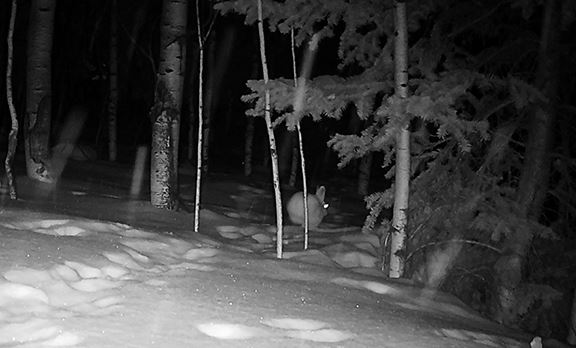 A snowshoe hare on Smuggler Mountain Open Space.